Andy Benzo
Every profession has a defining moment. For translators and interpreters, that moment is now. Artificial intelligence is changing how we work, how we communicate, and how we define expertise. Every day, technology becomes faster, more capable, and more accessible. Yet amid this extraordinary progress, one question continues to guide my work: What remains uniquely human?
I believe the answer is not simply language. It is judgment. Ethics. Responsibility. Leadership. It is what I call the human signature.
My journey began in Rosario, Argentina, where I studied both Law and Translation. Those two disciplines taught me something that continues to shape every decision I make today. Words are never just words. Behind every legal document is a person's future. Behind every translation is a culture. Behind every decision is a set of values. Language has never been only about communication. It is about understanding people, preserving meaning, and building trust.
That conviction eventually brought me to the United States, where I have spent more than two decades building a career as a legal translator, educator, researcher, and leader.
Throughout my career, I have translated thousands of legal documents, taught future language professionals, contributed to international standards, and collaborated with organizations around the world. I have had the privilege of serving as President of the American Translators Association, representing one of the largest professional communities of translators and interpreters worldwide. Each of those experiences reinforced the same lesson: technology changes our tools. It does not replace our responsibility.
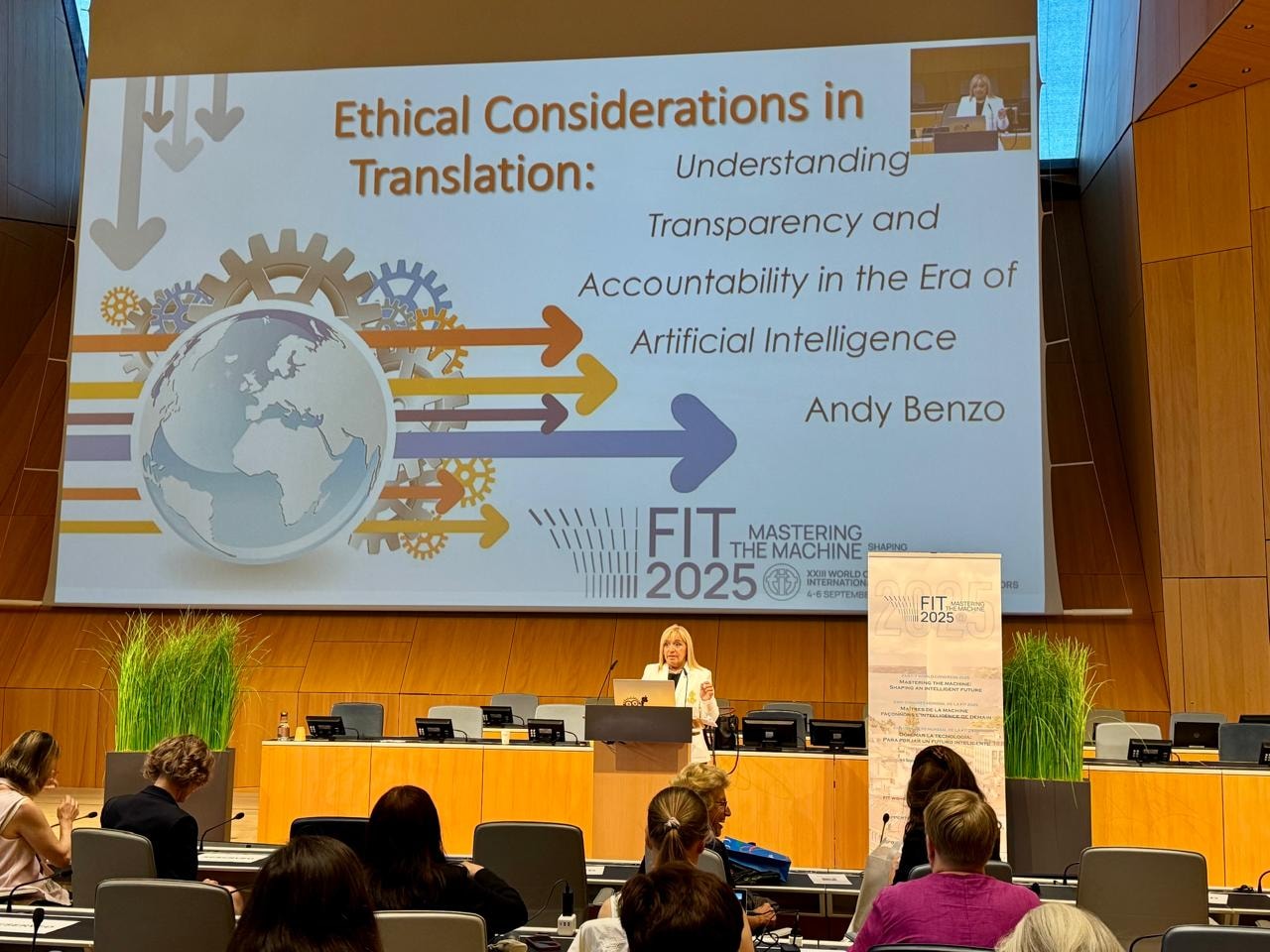
Today, my work extends far beyond translation. I speak internationally about artificial intelligence, ethics, language, and leadership because these conversations no longer belong to a single profession. Every organization is asking the same questions. How do we use AI responsibly? How do we preserve human judgment? How do we build trust when technology can produce information faster than people can verify it? How do professionals continue to create value in a world where knowledge is increasingly automated? These are leadership questions before they are technology questions.
My research and writing explore the intersection of AI, ethics, language, and law. Rather than viewing artificial intelligence as a replacement for human expertise, I see it as an invitation to redefine it. The future belongs to professionals who know how to ask better questions, exercise sound judgment, interpret context, and lead with integrity. The future belongs to people who understand that meaning cannot be automated.
This philosophy became the foundation of The Human Signature, my ongoing body of work exploring the role of human agency in an AI-driven world. The Human Signature is the imprint we leave through our judgment, our values, our ethics, and our capacity to understand meaning beyond information. It is the uniquely human contribution that no algorithm can replicate. I believe this will become the defining professional advantage of our generation.
Whether I am speaking to global organizations, universities, government agencies, or professional associations, my purpose remains the same: to help people navigate technological change without losing sight of what makes us human. While artificial intelligence may transform the way we work, our humanity will continue to define why our work matters. And that is the signature worth preserving.